Move-on plans in supported housing:four myths and the facts.
Move-on plans in supported housing are easy to get wrong in both directions. Some teams write one for everyone, others leave it until the week someone leaves. Here are four common assumptions, what the sources actually say, and how to evidence move-on in a support file.
Contents
Key takeaways
- The proposed person-centred support standard no longer asks for a move-on plan for every resident. The government revised it "to recognise the fact that not all residents in supported housing will move on to other accommodation".
- The revised wording asks that "a plan is in place to support the resident to live as independently as possible and/or to develop resilience and skills to move on when ready for more independent living".
- The draft licensing regulations don't mention move-on at all. The standards aren't published or in force yet.
- In the file, move-on is the steps along the way, not the leaving date: the skills being built, the barriers, and what was tried.
Why move-on is in the support file
For a lot of transitional supported housing, moving on is the whole point of the stay. For other residents it isn't, and the proposed standards now say so. Either way, an auditor reading the file wants to see the same thing: progress towards what the plan says the resident is working on, and what's getting in the way.
The proposed person-centred support standard puts it plainly. It asks that "achieving agreed outcomes is demonstrated and barriers to achieving them is identified". Move-on is one of those outcomes for some residents. It's not a separate document that lives at the back of the file.
When I read a file, I look for the thread: what the resident said they wanted, what was done about it, and what happened. A move-on plan that nobody's touched since the first week doesn't give me that thread.
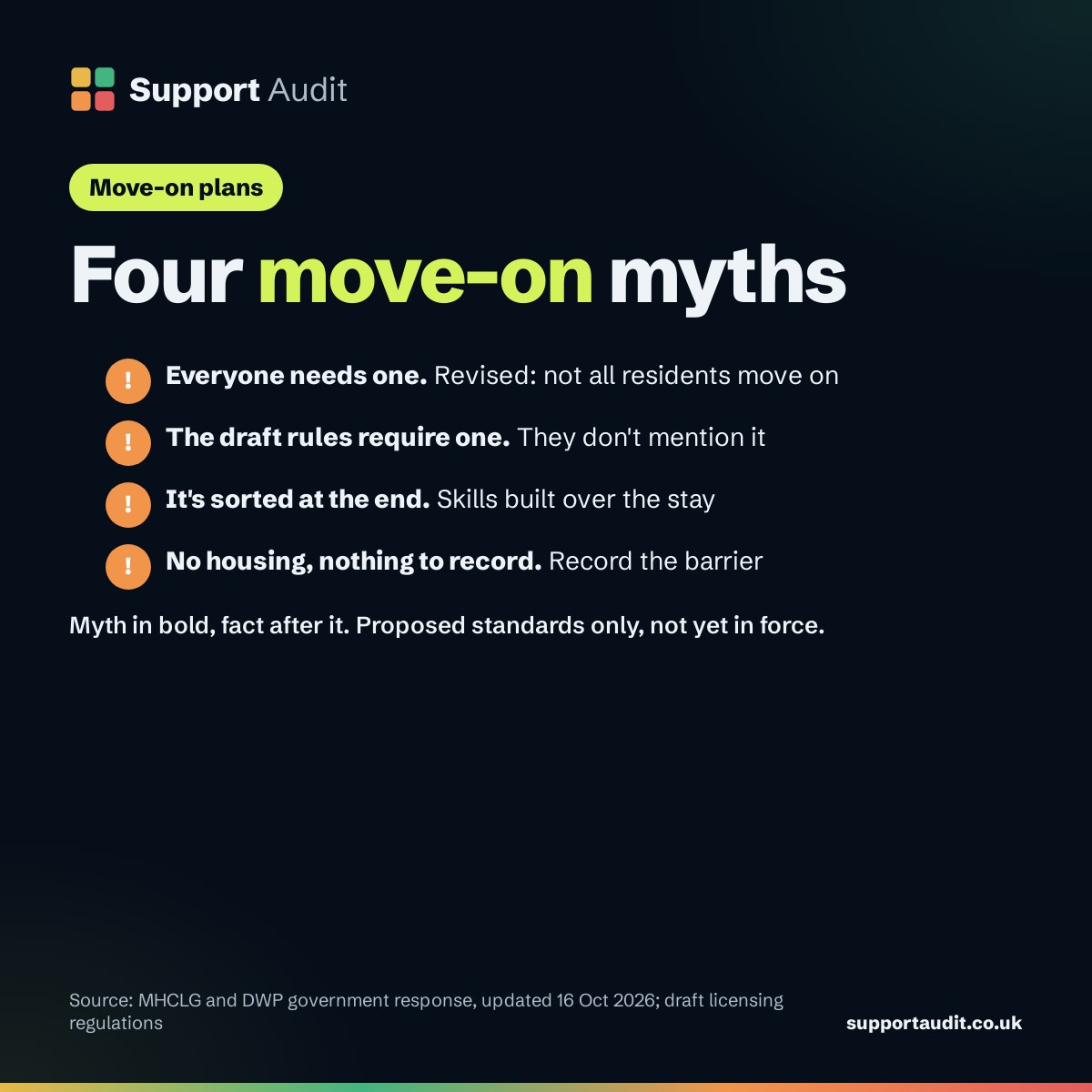
Myth 1: every resident needs a move-on plan
The fact: the first draft of the standards asked for a move-on plan to be in place where required. The government response, first published on 16 April 2026 and updated on 16 October 2026, says "Many respondents suggested that the requirements for the resident to have the same support worker wherever possible and for a move-on plan to be in place where required were too narrow."
So the requirement was revised "to recognise the fact that not all residents in supported housing will move on to other accommodation". The revised wording asks that "a plan is in place to support the resident to live as independently as possible and/or to develop resilience and skills to move on when ready for more independent living".
That "and/or" matters. A resident in long-term supported housing doesn't need a plan that pretends they're leaving. They need a plan for living as independently as they can, where they are.
Myth 2: the draft licensing rules make move-on plans compulsory
The fact: the draft Supported Housing (Licensing) (England) Regulations 2027 don't mention move-on. Schedule 3 has a heading on needs assessments, and paragraph 14 refers to "an assessment of the needs of each resident of the supported housing".
For when that assessment has to happen, and how to check it in a file, see supported housing needs assessments: check the dates first.
The move-on wording sits in the proposed National Supported Housing Standards, not in the draft regulations. Neither is in force. The draft regulations are out for consultation until 11:59pm on 10 December 2026.
Myth 3: move-on is something you sort out at the end
The fact: the revised wording is about developing "resilience and skills to move on when ready". Skills take time, so the evidence should build up over the whole stay, not appear in the last fortnight.
In practice that means goals you can see being worked on: managing a budget, keeping on top of bills, getting registered with a GP, getting on the housing register, going to a viewing. Each one is a goal with a date, a review and notes that mention it. None of that is in the standard word for word. It's what a file looks like when the standard's wording is being met.
Myth 4: if there's nowhere to move on to, there's nothing to record
The fact: the shortage came up in the consultation itself. Some respondents said "there is already not enough move on accommodation for residents". And the proposed standard asks for barriers to outcomes to be identified.
A lack of somewhere to go is a barrier, so the file should say so. What was applied for, when, what came back, and what you're doing in the meantime. A resident who's ready to move and has been waiting for months should have a file that shows that clearly. It protects them, and it protects you.
A worked example
This is an invented example, written to show the difference. It isn't from any real file.
Weak: the plan from the first week says "Move-on: to independent accommodation." The next mention is six months later: "Resident ready to move on. Awaiting housing."
An auditor can't tell what "ready" means, what was done to get there, or what anyone has done about the waiting.
Strong:
- Week 1: resident says they want their own flat within a year. Goal set: budgeting, with rent and bills paid on time for three months. Review in eight weeks.
- Week 6: on the housing register. Reference number recorded, band to be confirmed.
- Week 9: review. Two months of bills paid on time, one late payment, reason recorded. Goal carried on, new review date set.
- Week 20: three bids placed, no offers. Barrier recorded: few one-bed lets in the area. Plan updated to include a referral to the council's housing options team.
- Week 24: viewing attended with the support worker. Resident's view of the flat recorded in their words.
Five short entries, and anyone reading the file can follow the whole thread: what the resident wanted, what was done, what got in the way and what happened next.
Where this stops
The National Supported Housing Standards haven't been published and aren't in force. The draft Supported Housing (Licensing) (England) Regulations 2027 are a draft, out for consultation until 11:59pm on 10 December 2026. Nothing here is a rule yet.
This guide is about the support record. It isn't about when or how anyone's licence or tenancy ends. That's a legal question, and it needs your own legal advice.
Self-check: would your move-on evidence stand up?
Pull five files of residents who've been with you for six months or more and ask:
- Does the plan say whether move-on is a goal for this resident, and if it isn't, what living as independently as possible means for them?
- Is each skills goal dated, with a review that actually happened?
- Do the last four session notes mention a step towards that goal?
- Is every barrier recorded, with what was tried and when?
- For anyone who's left recently, does the file record the date and where they went?
For how to write the goals themselves, see individual support plan goals that pass an audit. For how each note should read, see how to write case notes that pass a support audit.
Three changes you could make this week
- Add one line to your support plan template: "Move-on: a goal now, not yet, or not applicable", with a space for the reason.
- Add a "barrier" field to your review form, with what was tried and the date.
- Check the files of everyone who left in the last three months. Each one should record the date they left and where they went.
Sources
- Supported Housing regulation consultation: government responseMHCLG and DWP · 16 April 2026, updated 16 October 2026 · person-centred support standard, move-on criterion
- Supported housing licensing regime: consultation on draft regulationsMHCLG · 15 October 2026, closes 11:59pm 10 December 2026
- Draft Supported Housing (Licensing) (England) Regulations 2027MHCLG · draft for consultation · Schedule 3, paragraph 14, needs assessments
This guide is about what good evidence looks like in a support file. It is not legal advice. The standards and licensing regulations quoted are proposals and may change.