Supported housing needs assessments:check the dates first.
A supported housing needs assessment is usually read for what it says. Start with when it was done. Three dates in the front of a file tell you whether the paperwork shows support starting when the stay did, and they take two minutes to check.
Contents
Key takeaways
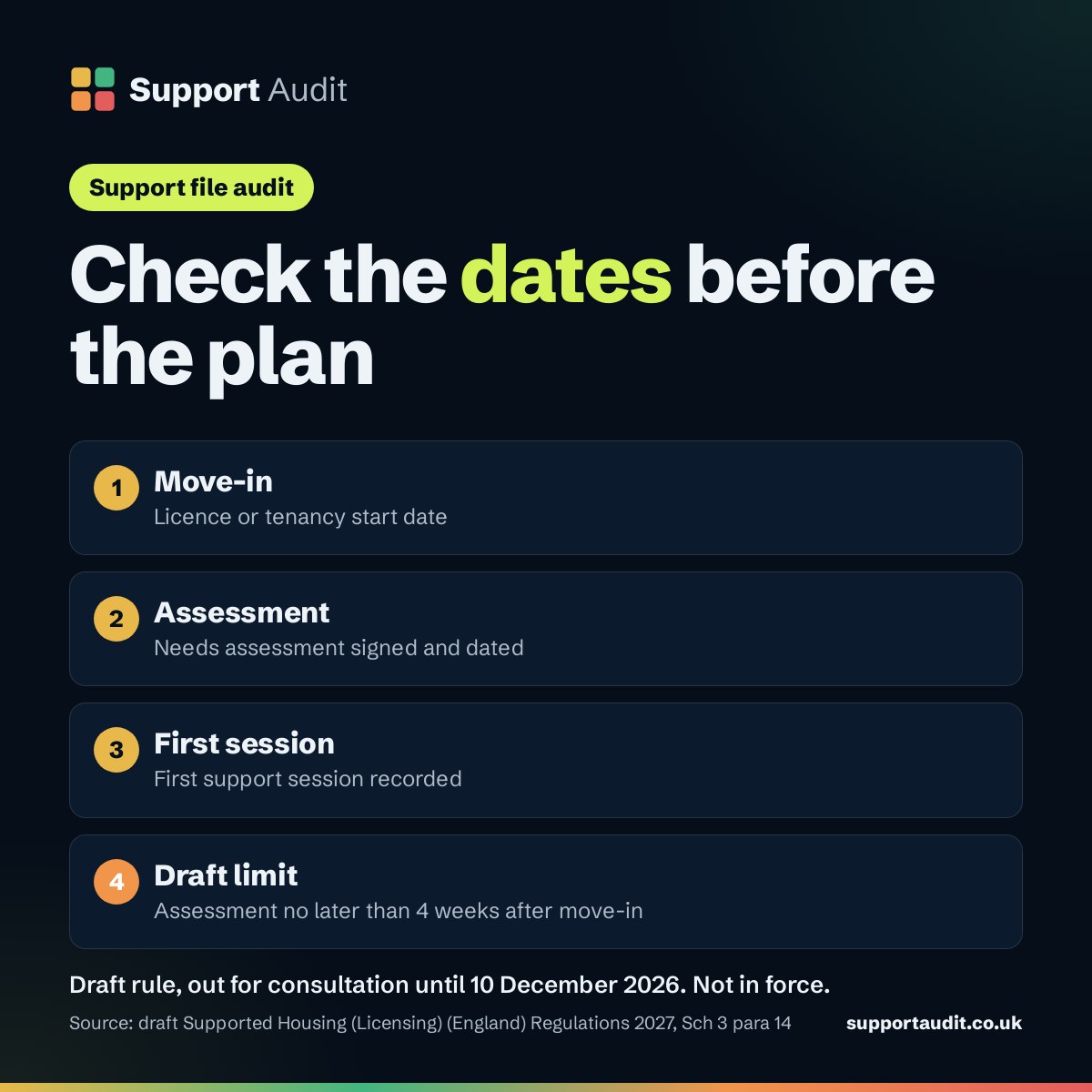
- Before you read a support plan, line up three dates: when the licence or tenancy started, when the needs assessment was done, and when the first support session was recorded.
- The draft licensing regulations propose a needs assessment "no later than 4 weeks after the date on which the person starts living in the housing", by "a suitable skilled person". It's a draft and not in force.
- The government response said an assessment must be done "either before the resident moves in, or no more than four weeks after". The draft only sets the outer limit.
- Four weeks is a ceiling, not a target. The file still has to show what support happened in those weeks.
Why the dates come first
Most people open a support file at the support plan. It's the document with the most in it, so it feels like the right place to start. But the plan can only tell you what was intended. The dates tell you when anything started.
If someone moved in on one date and their needs assessment was signed several weeks later, the file is saying something before you've read a word of it. The support might have been good from the first day. On paper, it began later than the stay did.
That matters to two kinds of reader. If you're setting up or taking on schemes, it's what you'll be asked to show. If you're a landlord, a council or a commissioner, it's one of the quickest ways to see whether the records behind a service hold together.
The three dates
- Move-in. The start date on the licence or tenancy agreement. Not the referral date and not the date the room was offered.
- Needs assessment. The date the assessment was completed and signed, and who did it.
- First support session. The first recorded session after the assessment, with a note of what was done. Not a welcome visit or a key handover.
Put the three side by side for each resident. The questions are simple. Is the assessment dated before move-in, or soon after it? Does the first session follow the assessment? And if there's a gap, does the file say why?
What the draft licensing rules say
The draft Supported Housing (Licensing) (England) Regulations 2027 put a deadline on one of the three. Schedule 3, paragraph 14 says "The licence holder must ensure an assessment of the needs of each resident of the supported housing is carried out no later than 4 weeks after the date on which the person starts living in the housing."
Paragraph 15 says the assessment "must be conducted by a suitable skilled person in accordance with any national standards relating to such assessments published, and not withdrawn," under section 3 of the 2023 Act.
Here's the part that's easy to miss. The government response to the supported housing regulation consultation, published on 16 April 2026 and updated on 16 October 2026, said that "a needs assessment must be undertaken either before the resident moves in, or no more than four weeks after they have moved in", and that it "should be undertaken by a suitably skilled and experienced person". The draft keeps the four-week limit but doesn't mention doing it before move-in, and its wording is "a suitable skilled person".
Schedule 3 of the draft doesn't mention support plans or records of support. So the four weeks is the only date it fixes. Everything else about what happened in those weeks has to come from your own records.
A worked example
This is an invented example, written to show the difference. It isn't from any real file.
Weak: licence starts on 3 March. The needs assessment is dated 27 March and signed by "staff". The first session note is 2 April: "Settling in well, no concerns." Nothing in between.
The assessment is inside four weeks, so on the draft wording alone it might pass. But the file can't show who assessed, what support happened in the first three and a half weeks, or why the assessment took that long.
Strong:
- 3 March: licence starts. Same day, an initial risk and needs conversation is recorded, with what was agreed for the first week.
- 5 March: first support session. Note says what was discussed, what the resident said and what the worker did next.
- 10 March: full needs assessment completed and signed by the named senior support worker, with their role.
- 12 March: support plan agreed, with goals that come from the assessment and a review date.
Four short entries. Anyone reading the file can see support starting on the day the stay did, who assessed, and how the plan follows from the assessment.
Where this stops
The draft Supported Housing (Licensing) (England) Regulations 2027 are a draft, out for consultation until 11:59pm on 10 December 2026. Nothing in them is in force, and the wording may change. The National Supported Housing Standards referred to in paragraph 15 haven't been published.
This guide is about what the support record shows. It isn't about Housing Benefit decisions, licence terms or anyone's legal position. Those need their own advice.
Self-check: line up your last five admissions
- Is the move-in date the licence or tenancy start date, and is it on the front of the file?
- Is the needs assessment dated, signed, and does it say who did it and in what role?
- Is the gap between move-in and assessment four weeks or less, and if it's more than a few days, is the reason recorded?
- Is there a recorded support session before or soon after the assessment, with something in it beyond "settling in"?
- Does the support plan come after the assessment and use what it found?
For how the plan's goals should read, see individual support plan goals that pass an audit. For the notes that follow, see how to write case notes that pass a support audit.
Three changes you could make this week
- Add a "key dates" box to the front sheet of every file: move-in, assessment, first session, plan agreed.
- Add "completed by" and "role" fields to your needs assessment template, next to the date.
- Pull your last five admissions, line up the three dates, and write a one-line reason on any file where the gap is longer than you'd want to explain.
Sources
- Draft Supported Housing (Licensing) (England) Regulations 2027MHCLG · draft for consultation · Schedule 3, paragraphs 14 and 15, needs assessments
- Supported housing licensing regime: consultation on draft regulationsMHCLG · 15 October 2026, closes 11:59pm 10 December 2026
- Supported Housing regulation consultation: government responseMHCLG and DWP · 16 April 2026, updated 16 October 2026 · needs assessments
This guide is about what good evidence looks like in a support file. It is not legal advice. The licensing regulations quoted are a draft and may change.