Birmingham exempt accommodation inquiry:what the files will show.
The government is reported to be launching an independent inquiry into supported exempt accommodation in Birmingham. Here is what has been reported, what an eight-week review is likely to lean on, and five questions to ask of your own files this week.
Contents
Key takeaways
- Birmingham Live reported on 23 November that the government will announce an independent inquiry into supported exempt accommodation in Birmingham. At the time of writing it had not been formally confirmed.
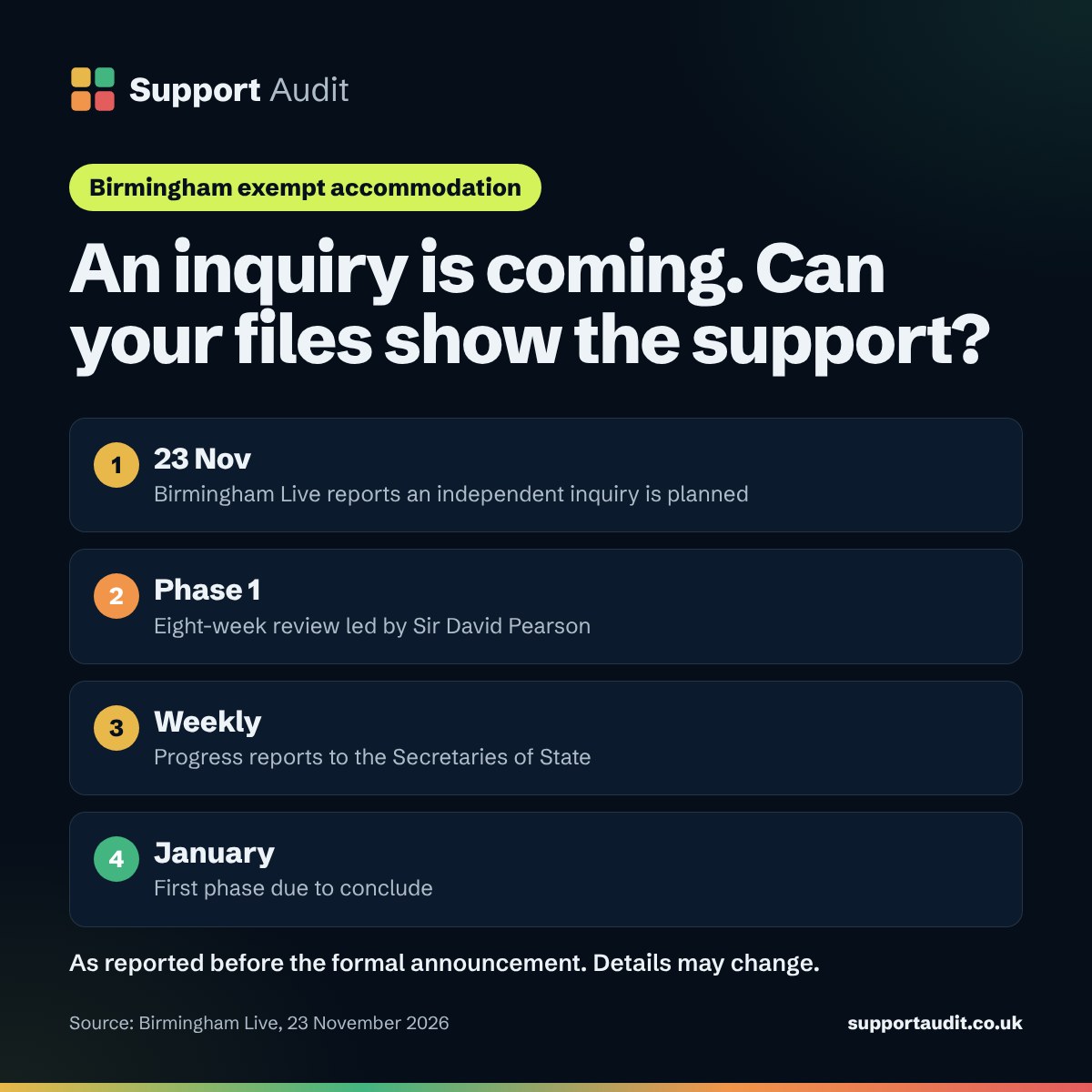
- The first phase, as reported, is an eight-week review led by Sir David Pearson, chair of the government’s Advisory Panel on Supported Housing, due to conclude in January.
- One question it is reported to look at is whether this is a Birmingham problem or a national one, and whether the city needs special powers or more funding.
- Eight weeks is short. A review on that timescale will lean on what providers can show, not what their policies say.
- The practical step is the same either way: check that your resident files show assessments, plans, sessions and reviews with dates, names and reasons.
What has been reported
On 23 November 2026, Birmingham Live reported that the government will announce an independent inquiry into supported exempt accommodation in Birmingham. It said it had seen a briefing document sent to the city council, with formal confirmation expected the next day. BBC News reported on 24 November that an announcement was expected.
According to the draft documents Birmingham Live described, the review runs in two phases. The first is led by Sir David Pearson, chair of the government’s recently created Advisory Panel on Supported Housing. He is to be supported by officials from the Department for Work and Pensions and the Ministry of Housing, Communities and Local Government, and possibly the Regulator of Social Housing.
That first phase is reported as an eight-week probe, starting immediately and expected to conclude in January, with weekly progress reports to the Secretaries of State. It is to look at why Birmingham has become the centre of the sector and what action is needed there specifically.
Why Birmingham
None of this comes out of nowhere. BBC News reports that more than 34,000 people in Birmingham live in supported exempt accommodation. In July 2026 the city council held a roundtable with local and national partners, where its leader said the scale and concentration of the sector was harming the city.
The council is still waiting for the Supported Housing (Regulatory Oversight) Act 2023 to take effect. The draft licensing regulations are out for consultation until 10 December 2026 and are not in force. In the meantime, the reported review is to consider whether Birmingham’s situation is local or national, and whether the city needs special powers or more funding.
Why the files matter
An eight-week review can’t visit every scheme. What it can do is ask for evidence, and in supported housing the evidence of support is the resident file.
The question that runs through all of the reporting is whether support is actually being delivered for the money paid. A policy that says you assess, plan and review answers none of that. A file with a dated needs assessment, a plan that uses it, recorded sessions and reviews done on time does.
In my years in supported housing, the gap is rarely intent. It’s the record. The support happened, but the file can’t show it, or shows it with no date, no name and no review. Under scrutiny, that reads the same as support that didn’t happen.
That holds whether you are in Birmingham or not. The review is reported to be asking whether this is a national issue, and the licensing regime, when it comes, applies across England.
Where this stops
This guide is based on reporting of draft documents, published before the formal announcement. The scope, timetable and who is involved may change once the government confirms the details. What Birmingham Live published did not describe the second phase in detail, so this guide doesn’t either.
It is about what the support record shows. It isn’t about Housing Benefit decisions, enforcement or anyone’s legal position. Those need their own advice.
Self-check: five files, picked at random
- Is there a needs assessment, dated and signed, with who did it and in what role?
- Does the support plan come after the assessment and use what it found?
- Are support sessions recorded, dated and specific, rather than “resident fine, no issues”?
- Was the last plan review done on or before its due date, and if not, is the reason recorded?
- Where a session was missed, does the file say why and what happened next?
For the dates to check first, see supported housing needs assessments: check the dates first. For missed sessions, see missed support sessions: a simple process that passes an audit. For what a complete file contains, see what a good resident support file contains.
Three changes you could make this week
- Pull five resident files at random and run the self-check above. Time how long it takes to answer each question.
- Put the next review due date on the front of every support plan, so a late review is spotted before it happens.
- Agree who in your organisation would pull files together if asked, and where the current versions live.
Sources
- Exclusive: Government to launch inquiry into Birmingham’s exempt housing scandalBirmingham Live · 23 November 2026 · reported plan, phases and timetable
- Inquiry expected into housing scheme ‘exploitation’BBC News, via Yahoo News · 24 November 2026 · number of residents in Birmingham
- Roundtable event focuses on tackling crime and poor standards in supported housingBirmingham City Council · 10 July 2026
- Supported housing licensing regime: consultation on draft regulationsMHCLG · 15 October 2026, closes 11:59pm 10 December 2026
This guide is about what good evidence looks like in a support file. It is not legal advice. The inquiry details are as reported before the formal announcement and may change.