Intensive housing management:does the schedule match the notes?
An intensive housing management schedule says what the service is. The support notes say what happened. When a council asks for a breakdown of the charge, the two get read together, and they should describe the same service.
Contents
Key takeaways
- Intensive housing management is often used as an umbrella term for a range of charges. DWP guidance tells councils to ask for a breakdown and deduct anything ineligible or duplicated.
- Support itself can never be paid for by Housing Benefit. Charges for care, support or supervision are ineligible, whoever provides the service.
- Whether the support is enough is judged claim by claim, on what was actually done as well as the time spent. The notes are where that shows.
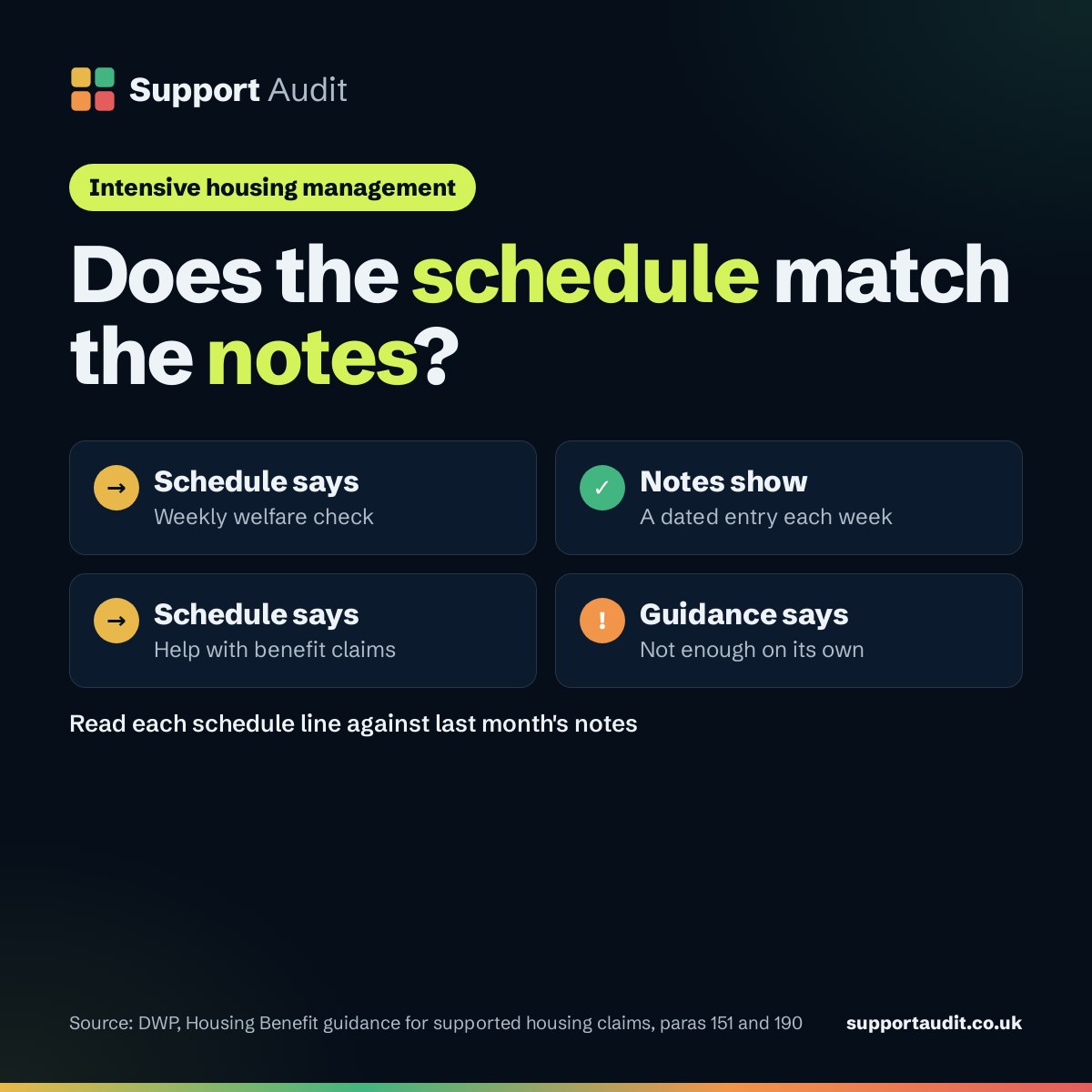
- The test is simple: read each line of the schedule next to last month's notes and mark whether the notes show it happening.
What an intensive housing management schedule is for
Intensive housing management is a service charge question before it's a support question. DWP's Housing Benefit guidance for supported housing claims describes it as "the housing management tasks that supported housing providers perform (sometimes with greater intensity) in addition to the duties of a general needs landlord" (paragraph 189).
The same guidance is plain about how the term gets used now. Paragraph 190 says intensive housing management "and similar terms" are "now often used by landlords as an umbrella term to cover a range of charges", and that the council "should ask for a breakdown of these charges and then identify and deduct any ineligible or duplicate charges".
So the schedule is a document someone will read line by line. Each line is a claim that a service exists, and that it's housing management rather than support.
What the notes have to carry
Support can't be funded through Housing Benefit at all. Paragraph 188 says "All charges for care, support or supervision services are ineligible. The provider of the care or support service is irrelevant". But exempt accommodation still depends on support being there: the definition in Schedule 3, paragraph 4(10) of the Housing Benefit (Consequential Provisions) Regulations 2006 needs the landlord, or someone acting on its behalf, to provide the claimant with "care, support or supervision".
And it has to be enough. Paragraph 150 of the guidance says the amount "must be more than minimal" and "Each claim must be assessed individually". Paragraph 151 says there's no set number of hours, and that "the activities performed in providing it must be considered (alongside the time spent)". It gives an example of what doesn't count by itself: "helping with benefit claims and carrying out safety/security inspections is not enough on its own".
That puts a lot of weight on the support notes. They're the only document that shows, resident by resident, what was done and when. A schedule can describe a service accurately and still be more ambitious than the recording behind it. The gap only shows when the two are read side by side.
Side by side: the schedule line and the note
These schedule lines are invented, generic examples, not taken from any real schedule. The right-hand column is what a reader would expect to find in the notes if the line is true.
| What the schedule says | What the notes would need to show |
|---|---|
| Weekly welfare check for each resident | A dated entry for each week the resident was there, saying who checked and what they found. Missed weeks recorded as missed, with the reason. |
| Help with benefit claims and appointments | The claim or appointment, what the worker did, and the outcome or the next step. |
| Tenancy sustainment and arrears support | When arrears were raised with the resident, what was agreed, and whether it was followed up. |
| Regular checks on the building and the room | A dated record of each check and anything reported. Useful, but on the guidance's own example, checks like these aren't enough on their own to count as support. |
None of this asks for long notes. It asks for the notes and the schedule to be about the same service. A schedule line with no trace in a month of notes is the one a reader will ask about first.
This works in both directions. If you're setting up or taking on schemes, it's what you'll be asked to show. If you're a landlord, a council or a commissioner, it's a quick way to see whether the service charged for is the service recorded.
Where this stops
Deciding what is eligible for Housing Benefit, and how much to deduct, is the council's decision on each claim. DWP's guidance is written for councils making those decisions. This guide doesn't say whether any charge is eligible, and it isn't advice on how to set or split a charge.
It's about one thing: whether the records show the service the schedule describes. That's an audit question, and it's one you can answer from your own files.
Self-check: three residents, one month
- Take the current intensive housing management schedule and three residents' notes for last month.
- For each line of the schedule, mark each resident's notes: shown, partly shown, or not shown.
- For any line marked "not shown" for all three, decide which is wrong: the schedule or the recording.
- Check that each note says who did the work and on what date.
- Check that support sessions and housing management tasks are recorded clearly enough to tell apart.
For what a good session note contains, see how to write case notes that pass a support audit. For weeks when a session doesn't happen, see missed support sessions: a simple process.
Three changes you could make this week
- Give each line of the schedule a short code, and add a matching tick-box or tag to your note template so staff can record which service an entry covers.
- Add a "not done this week, because..." line to the note template for any scheduled task that didn't happen.
- Book a monthly ten-minute read of one resident's notes against the schedule, and write down what didn't match.
Sources
- Housing Benefit guidance for supported housing claimsDWP · updated 1 April 2026 · paragraphs 150, 151, 188, 189 and 190
- The Housing Benefit (Consequential Provisions) Regulations 2006, Schedule 3, paragraph 4legislation.gov.uk · SI 2006/217 · definition of exempt accommodation, paragraph 4(10)
This guide is about what good evidence looks like in a support file. It is not legal advice and it does not say whether any charge is eligible for Housing Benefit.